Chinese Classical Pavilion Model
A double-eaved octagonal pavilion model crafted through traditional woodworking techniques
Overview
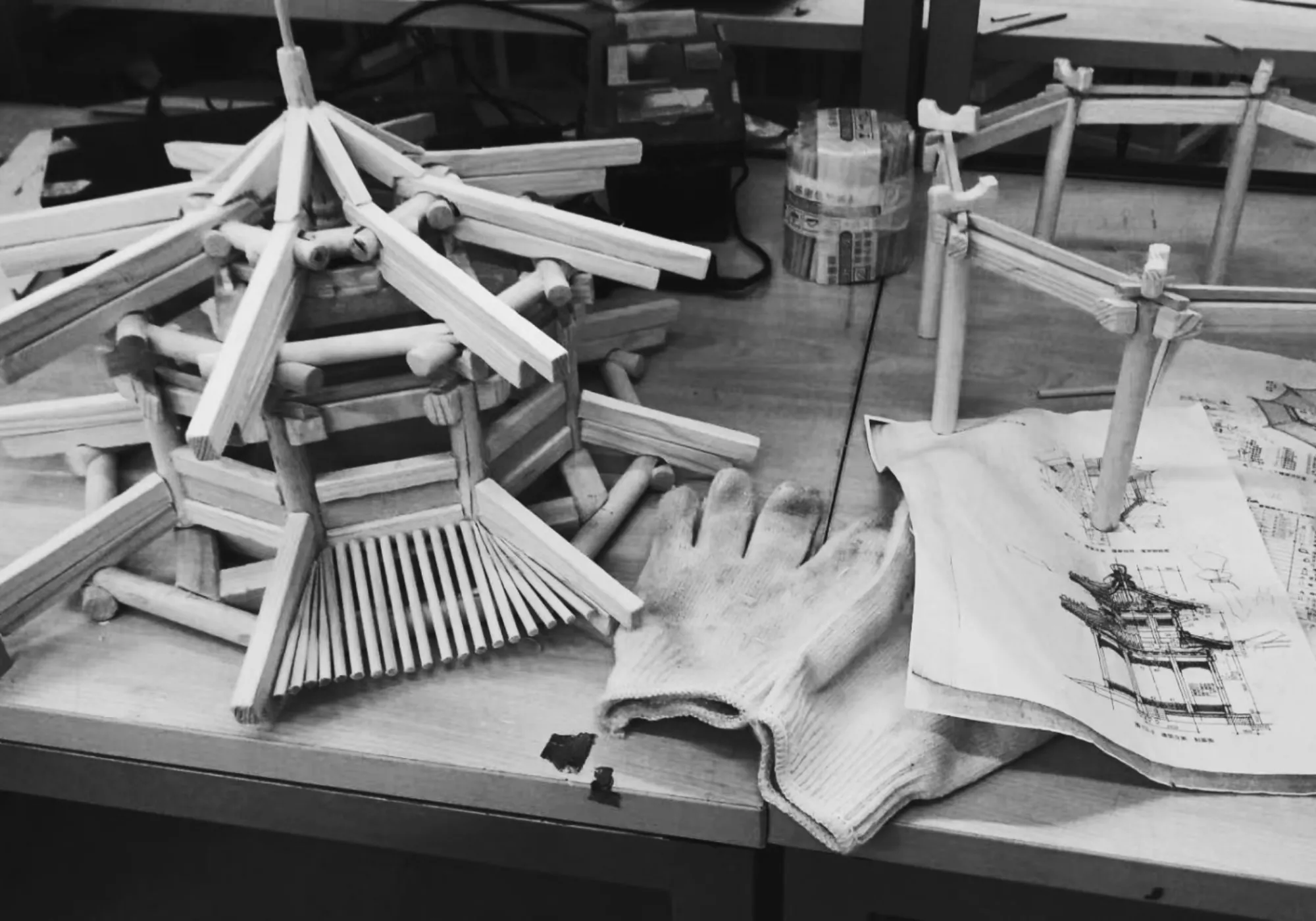
Different sizes of round logs and square timber, a handheld angle grinder, empty wallets, countless days and nights in the specialized workshop.
Details
About the Project
The objective entails selecting a classical pavilion architectural style, such as a round pavilion, square pavilion, double-eaved pavilion, and the like, and subsequently implementing its construction through woodworking techniques. As a general rule, the more elevated the degree of complexity, the higher the attainable score.
Starting the Project
I opted for the most demanding style: the double-eaved octagonal pavilion. Initially, I entertained the notion that its complexity might not be as formidable. Yet, as I delved into the process, I came to realize that its degree of intricacy was indeed remarkably elevated.
Summary
The whole process was quite challenging. Since there were no ready-made blueprints for the double-eaved octagonal pavilion, we had to scour the library for books on pavilions. Eventually, we found relevant information and painstakingly learned the names of each component, counted quantities, and calculated proportions. I divided the building into three separable parts for assembly. I spent a significant amount of time on it while my peers working on simpler pavilions were already playing games.
Unfortunately, I wasn't able to take many photos of the final model. It was taken by the teacher and placed in their display room.